



DTG vs Screen Printing vs Sublimation: Which Is Right for Your Order?
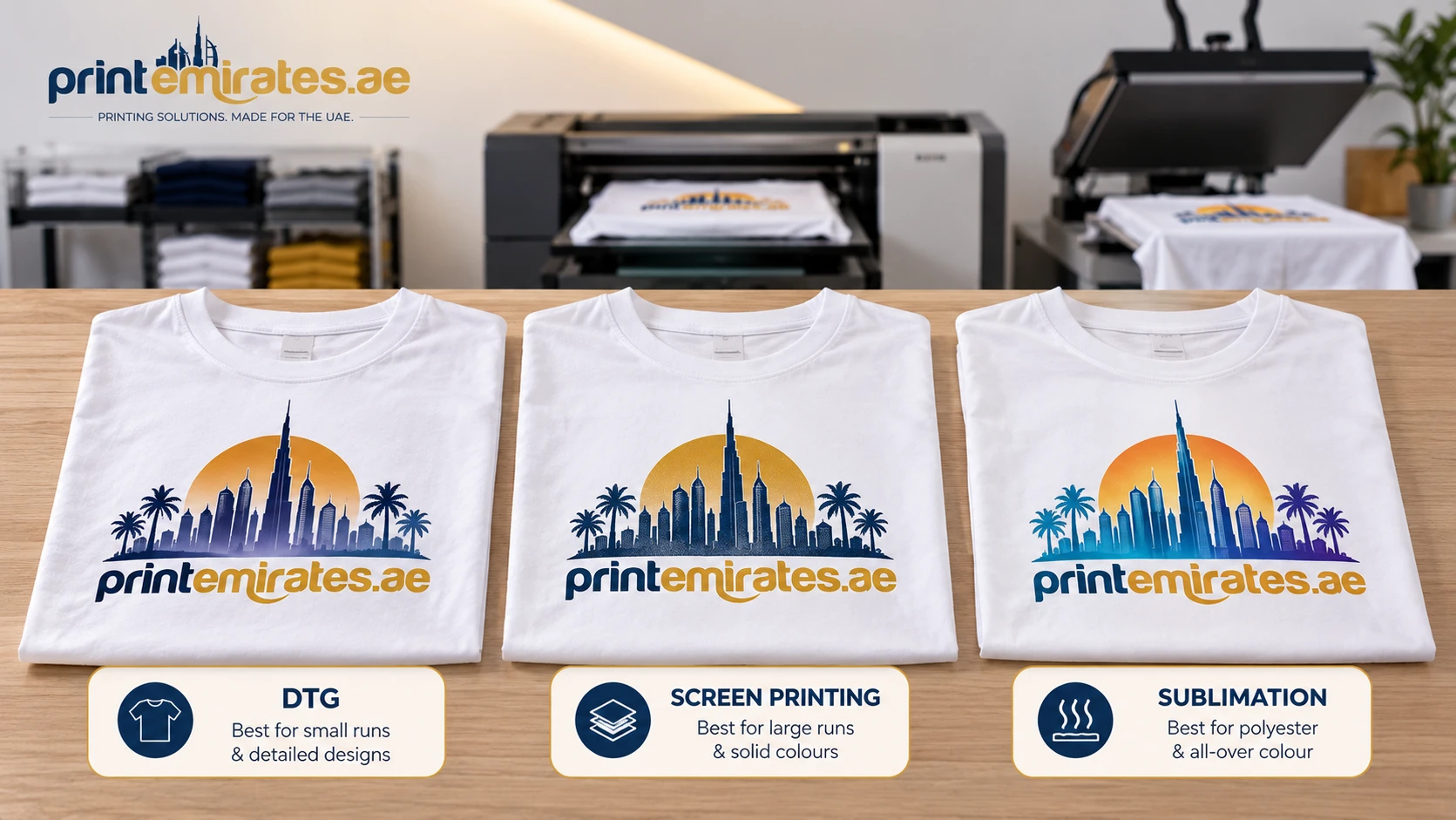
Choosing between DTG vs screen printing vs sublimation comes down to three questions: what fabric, how many pieces, and how complex the design. Screen printing wins on large runs of simple designs, DTG wins on small runs of detailed artwork on cotton, and sublimation wins on all-over color on polyester. The sections below give the detail and a scenario table.
How the three methods work
Direct-to-garment (DTG)
DTG is inkjet printing onto fabric. The garment is pre-treated, loaded flat onto a platen, printed with water-based pigment inks, and then heat-cured. There are no screens or plates; each shirt can carry a different image at no extra set-up cost.
Screen printing
Screen printing pushes plastisol or water-based ink through a mesh stencil, one screen per color. Setup involves making film positives, coating and exposing screens, and registering them on the press. Once set up, each print takes seconds, so unit cost falls sharply as quantity rises.
Dye sublimation
Sublimation prints the design in reverse onto transfer paper with sublimation inks, then presses it against polyester fabric at around 200°C. The ink turns to gas and bonds with the polyester fibers, so there is no ink layer on the surface. It only works on polyester or polymer-coated surfaces and only on white or very light colors.
DTG vs screen printing vs sublimation at a glance
Factor | DTG | Screen printing | Sublimation |
Best fabric | 100% cotton, cotton-rich blends | Cotton, blends, and most polyester with the right ink | 100% polyester (or 65%+ poly), white or light base |
Dark garments | Yes, with a white underbase | Yes, with underbase or opaque ink | No |
Colors per design | Unlimited, full photographic | Priced per color; 1–6 typical | Unlimited, full photographic |
Gradients and photos | Excellent | Limited; needs halftones | Excellent |
Fine detail and small text | Very good | Good above the 0.5 pt line | Very good |
Run size sweet spot | 1–50 pieces | 50–5,000+ pieces | 1–200 pieces, or any size for all-over |
Set-up cost | Minimal | Per screen, per color | Minimal |
Unit cost trend | Flat regardless of quantity | Falls steeply with quantity | Fairly flat |
Hand feel | Soft on light shirts; slight film on dark | Ink layer you can feel; soft-hand inks are available. | None, it feels like plain fabric. |
Wash durability | Good; fades gradually over many washes | Very good; cracks only if under-cured | Excellent; cannot peel or crack |
Print area | Limited to platen size, usually A3 or A2 | Standard chest and back areas; oversize possible | Full garment, all-over, seam to seam |
Lead time | Short; no screen making | Longer; screens and drying | Short to medium |
Fabric compatibility
In any DTG vs screen printing vs sublimation decision, fabric matters more than anything else.
Cotton
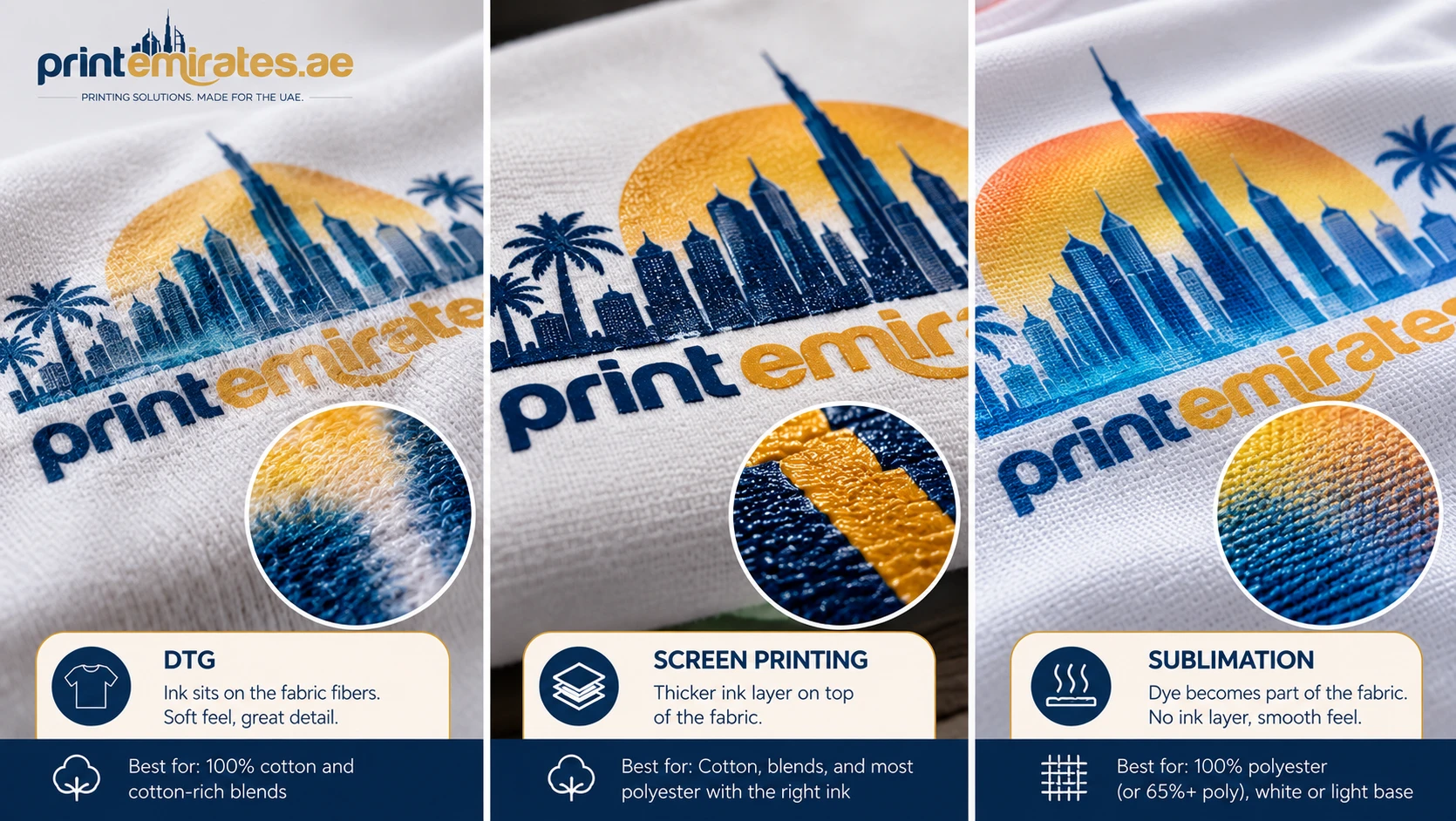
DTG inks bond with natural fibers, so 100% cotton ring-spun tees give the sharpest, most vibrant DTG results. Screen printing also performs well on cotton. Sublimation does not work on cotton at all; the dye has nothing to bond to and washes out.
Polyester and performance fabrics
Sublimation is designed for polyester and is the standard method for sports kits, gym wear, and performance polos. Screen printing on polyester needs low-bleed inks to stop dye migration (garment color bleeding into the print). DTG on polyester is possible with special pre-treatment, but results vary and durability is lower.
Blends
A 50/50 or 60/40 cotton-polyester blend prints well with screen printing and acceptably with DTG (expect slightly muted color). Sublimation on a 50/50 blend gives a faded look because only the polyester half takes the dye. Some buyers want that effect; most corporate buyers do not.
Thet-shirt rangelists fabric compositions for each garment so you can match the method before ordering.
Color and gradient handling
DTG and sublimation are both four-color (or more) digital processes and reproduce photographs, gradients, and dozens of colors in one pass without extra cost. Screen printing reproduces spot colors precisely, which is why it is preferred for exact Pantone brand colors, but every additionalcolor adds a screen, a setup charge, and a registration risk.
Gradients in screen printing are handled with halftone dots. If your design has a photographic element or more than about six colors, DTG or sublimation will look better and cost less at small volumes.
On dark garments, DTG lays a white underbase first, then color on top. The print sits more on the surface and feels heavier than on white cotton.
Run-size economics
Cost structure explains most buying decisions.
- Screen printinghas a fixed set-up cost per color, then a low unit cost. A one-color design on 200 shirts is cheap per piece; the same design on 10 shirts carries the full setup cost.
- DTGhas almost no set-up. The unit cost is the same for shirt 1 and shirt 100, driven by ink coverage and print area. It is the cheapest option under roughly 30–50 pieces and rarely the cheapest above 100.
- Sublimationon cut-and-sew all-over garments is priced by the garment, not the number of colors. For placement prints on ready-made polyester shirts, its cost sits between DTG and screen printing at small volumes.
Ask for a quote at two or three quantities to see where the curve changes. Forexhibition giveaway t-shirtsordered in the hundreds, screen printing will almost always be the answer.
Durability, wash, and feel
Wash durability
Sublimation is the most durable because the dye is inside the fiber; it will not crack, peel, or fade noticeably for the life of the garment. Well-cured screen printing is next; plastisol can survive hundreds of washes, though it may crack if the garment is stretched hard or tumble-dried hot. DTG holds up well on cotton but fades gradually; wash cold and inside out.
Hand feel
Sublimation has no feel. DTG on white or light cotton is very soft because the ink soaks in. DTG on dark cotton, with a white underbase, has a light film. Screen printing has a noticeable ink layer, especially with several colors; water-based and discharge inks reduce this.
Heat and UAE conditions
For uniforms worn outdoors in UAE summers, breathability matters. A heavy plastisol block traps heat. Sublimated polyester or a small screen-printed logo on a moisture-wicking polo is more comfortable. See theworkwear rangefor fabrics chosen for site and outdoor staff.
Setup, artwork, and lead time
Artwork requirements
DTG and sublimation take a high-resolution PNG or PDF at print size (300 dpi at final dimensions is the safe standard). Sublimation files must be mirrored by the printer, not by you. Screen printing needs vector artwork with each color on a separate layer or as a named spot color; small text below about 6 pt and thin lines will not hold on a screen. Theartwork guidecovers color mode, transparency, and file naming for apparel.
Lead time
Screen printing has the longest setup because screens must be made, dried, and registered. DTG and sublimation can start within minutes of artwork approval, which suits urgent event orders. Lead times vary with quantity and garment stock; ask the supplier for a written date.
Alternatives worth knowing
DTF (direct-to-film)
DTF prints the design onto a PET film with a hot-melt adhesive powder, then heat-presses it onto almost any fabric, including cotton, polyester, blends, and nylon. It handles full color, works on dark garments without pre-treatment, and is economical in small quantities. The print sits on the surface with a slightly rubbery feel.
Embroidery
Embroidery stitches the logo in thread and is the standard forpolo shirts, caps, and formal uniforms because it reads as durable and premium and outlasts every printed method. It cannot reproduce gradients, and stitch count drives price, so it suits logos rather than large graphics.
Which method to choose by scenario?
Your order | Recommended method | Why |
10 staff tees, full-color logo, cotton | DTG or DTF | No setup, full color, small run |
300 event tees, one or two colors | Screen printing | Lowest unit cost at volume |
500 exhibition giveaway tees, three colors | Screen printing | Set-up spread across many units |
Sports team kit, names and numbers, polyester | Sublimation | All-over, durable, no feel |
Corporate polos, small chest logo | Embroidery (or screen print) | Premium look, long life |
Outdoor site workwear, hi-vis polyester | Screen print with low-bleed ink or transfer | Durability on synthetic fabric |
Photographic design on 25 dark shirts | DTG with underbase or DTF | Full gradients on a dark base |
Mixed fabrics and sizes, 40 pieces, one design | DTF | Works on any fabric, one set-up |
Exact Pantone brand color, 150 shirts | Screen printing | Spot color accuracy |
Sublimation availability for placement or all-over garments at PrintEmirates is. DTG, screen printing, and embroidery are covered across theapparel range.
Ready to order printed t-shirts?
Tell us the quantity, fabric, and design, and we will recommend a method. Browse thecustom t-shirt rangeorcontact PrintEmiratesvia WhatsApp or the Get a Quote form with your artwork attached.
Frequently asked questions
Q. Is DTG or screen printing better for t-shirts?
For fewer than about 50 shirts or any design with photographs and gradients, DTG is usually better and cheaper. For larger runs of one to four solid colors, screen printing gives a lower unit cost and a more durable print. Fabric should be cotton or cotton-rich for either.
Q. Can sublimation print on black or cotton t-shirts?
No. Sublimation dye is transparent and bonds only with polyester, so it needs a white or very light polyester garment. For dark or cotton shirts with full-color designs, use DTG with a white underbase or DTF.
Q. Which method lasts longest in the wash?
Sublimation, because the dye is inside the fiber rather than on the surface. Properly cured screen printing is close behind. DTG is durable but fades gradually; washing it cold and inside out extends its life.
Q. What artwork file should I send?
For DTG, DTF, and sublimation, send a 300 dpi PNG or PDF at the final print size with a transparent background. For screen printing, send vector artwork (AI, EPS, or PDF) with spot colors named. Check the artwork guide before uploading.