





Matte vs Gloss vs Soft Touch Lamination: A Visual Guide
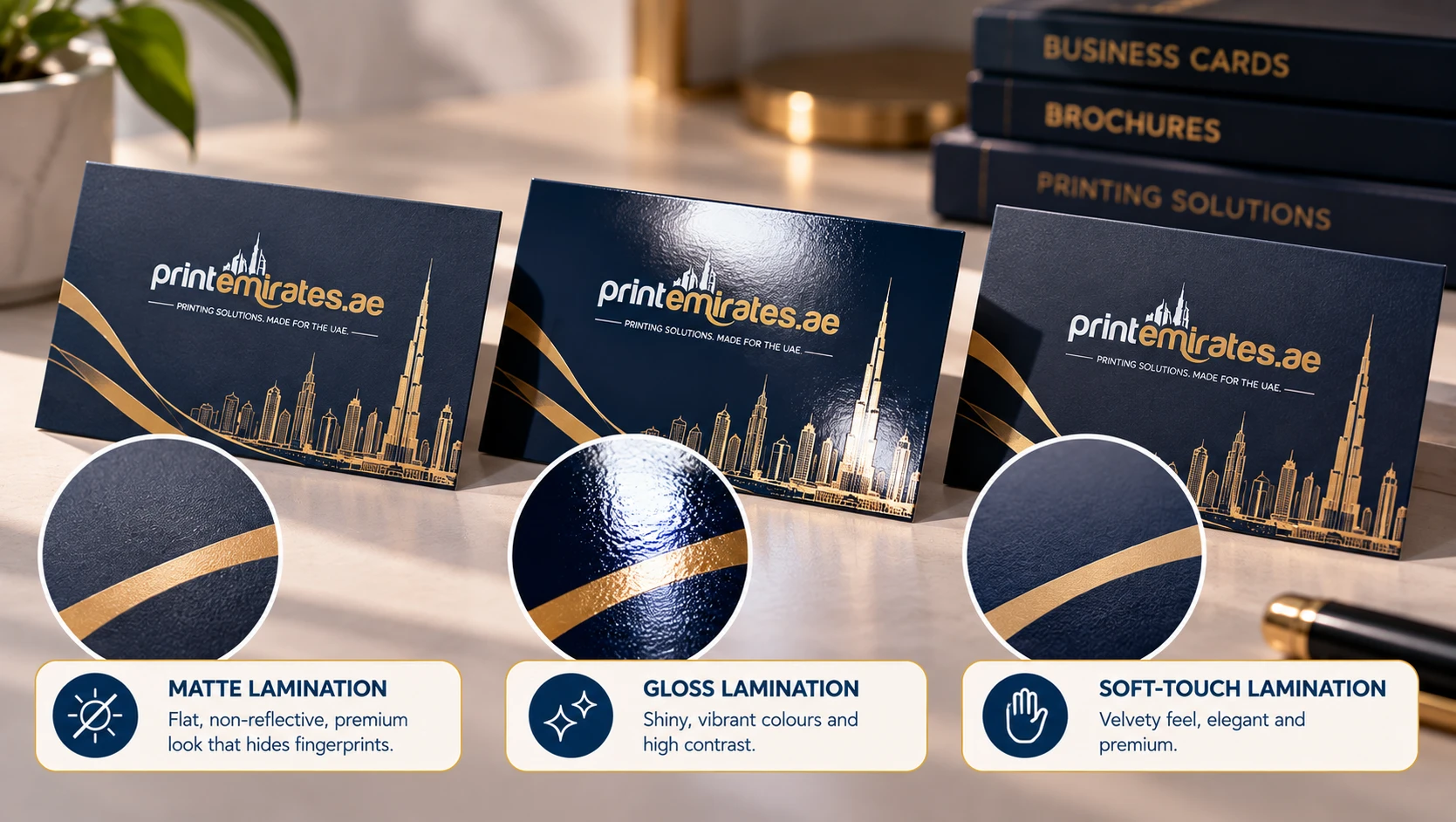
If you are weighing matte vs gloss vs soft-touch lamination, the short answer is gloss for color punch and photographs, matte for a calm, professional surface that hides fingerprints, and soft-touch for a velvet feel that people remember but that scuffs on dark colors. The rest of this guide shows how each finish behaves in the hand, under a camera and after a month in a wallet.
What lamination is?
Lamination bonds a thin clear polypropylene or polyester film over the printed sheet using heat and pressure. Films are typically 25–40 microns thick. The film protects the ink from moisture, fingerprints, and abrasion; stiffens the sheet slightly; and gives the surface its final look.
Lamination differs from varnish or aqueous coating, which are liquid coatings applied on press: thinner, cheaper, and less protective. On business cards, folders, and brochure covers, lamination is the standard finish because those items are handled repeatedly.
Business cards and folders are almost always laminated on both sides; a brochure cover is usually laminated on the outside only.
One note on spelling: UK printers and many UAE suppliers write“matt”rather than "matte." It is the same finish, and you will see both spellings on quotes.
Matte vs Gloss vs Soft Touch Lamination at a Glance!
Property | Matte | Gloss | Soft-touch |
Look. | Flat, non-reflective, muted | Shiny, high contrast, saturated | Flat, like matte, slightly deeper |
Feel | Smooth, dry, slightly waxy | Slick, hard | Velvet or peach skin, warm |
Fingerprints | Barely visible | Very visible | Visible on dark colors |
Scuffing | Light scuffs possible | Resists scuffs well | Scuffs and shine on dark areas |
Color effect | Softens and darkens slightly | Deepens and brightens | Softens more than matte |
Photographs well | Yes, no glare. | Glare under lights and flash | Yes, no glare. |
Writable | With ballpoint, with pressure | No | No |
Spot UV compatible | Ideal base | Little contrast | Works, strong contrast |
Typical cost | Standard | Standard | Higher |
Best on | Business cards, folders, covers | Flyers, photo brochures | Premium cards, luxury covers |
How does each finish looks, feels and photograph?
Matte lamination
Matte film diffuses light instead of reflecting it, so the surface has no hot spots and text stays readable at any angle. Colors lose a little saturation and appear slightly darker; a bright red reads a shade deeper than on screen.
In the hand, the mat is smooth and dry. It is the default forbusiness cardsacross law firms, consultancies, clinics, and most corporate offices in Dubai and Abu Dhabi because it looks considered without looking flashy. Under a phone camera or event flash, matte is the safest of the three: no glare across your logo.
Gloss lamination
Gloss film reflects light directly. Photographs and saturated graphics gain depth and appear sharper because the smooth surface keeps the ink from scattering light. This is why gloss is used onbrochureswith product photography, on flyers, and on children’s or leisure products.
The downsides are practical. Gloss shows every fingerprint, particularly on dark colors. It creates glare under office lighting and on camera, so a gloss business card photographed for LinkedIn or a website often shows a white streak. It cannot be written on, and text-heavy designs are harder to read at an angle.
Soft-touch (velvet) Lamination
Soft-touch film has a micro-textured surface that feels like suede or peach skin. It is the finish people notice first when they pick up a card. Visually it is similar to matte but slightly deeper, and it photographs without glare.
The trade-off is durability on dark artwork. Soft-touch film scuffs: fingernails, keys, and the edges of other cards leave shiny marks that show clearly on navy, black, and deep colors. On white or pale designs the marks are almost invisible. If your brand is dark and the card will live in a pocket, either accept some marking, pair soft-touch with a lighter background, or choose matte instead.
Writability, fingerprints, and scuffing in detail
Writing on laminated cards
Ballpoint ink sits on top of gloss and soft-touch film and smears off. Matte film accepts ballpoint with firm pressure, though it will never behave like uncoated paper. If people need to write on a card, such as an appointment card or a loyalty card, laminate the front only and leave the reverse uncoated, or skip lamination altogether.
Fingerprints
Gloss shows fingerprints most because skin oil disrupts the mirror surface. Matte hides them because the surface is already diffuse. Soft-touch sits between: on pale colors, prints are invisible; on dark colors, they show as faint shiny patches.
Scuffing and wear
Gloss is the most scuff-resistant of the three because the hard film takes abrasion without changing appearance. Matte picks up light polish marks over time, visible when the card is tilted. Soft-touch marks most readily. Forpresentation foldersthat will be carried in bags and handed across desks, matte or gloss will look newer for longer than soft-touch.
Color effect and how to prepare artwork
In the matte vs gloss vs soft-touch lamination comparison, all three films shift color slightly. Gloss brightens and increases apparent contrast. Matte and soft-touch soften and darken, with soft-touch having the stronger effect. Expect mid-tones to drop by a noticeable step under matte and pale tints to look flatter.
Practical adjustments:
- For matte or soft-touch, brighten pale tints and avoid very dark backgrounds with small dark text; contrast will fall.
- For gloss, check that large flat color areas are not so saturated that they look artificial.
- Do not rely on screen previews. Ask for a laminated sample or proof on the actual stock and film.
- Avoid heavy ink coverage right at fold lines on laminated covers; the film reduces cracking but does not remove it.
Artwork setup is otherwise unchanged: 3 mm bleed, CMYK, 300 dpi, and a print-ready PDF. If you are adding spot UV, supply the UV areas as a separate layer or a separate PDF in 100 percent black, as described in theartwork guide.
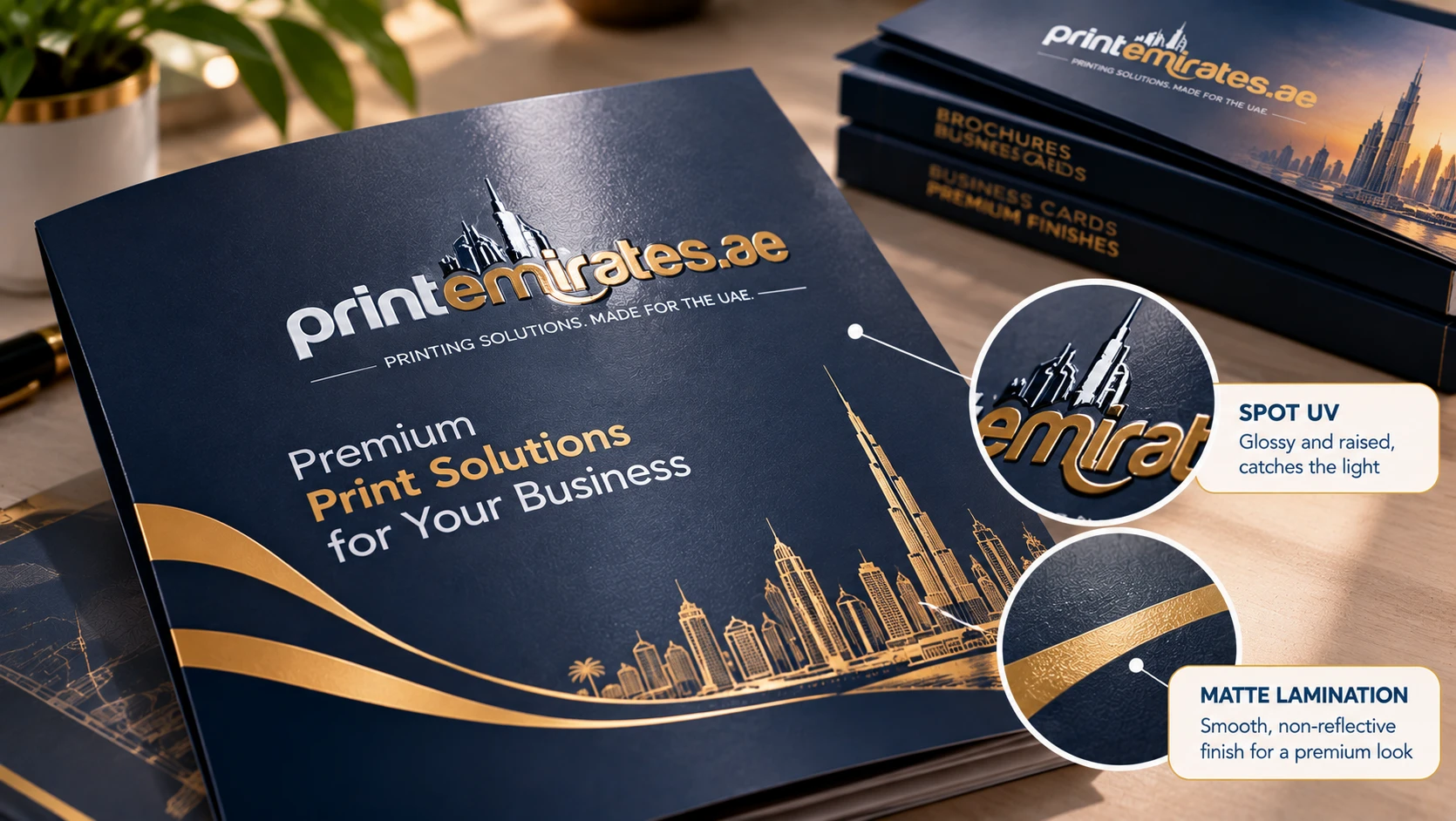
Spot UV over matte lamination
Spot UV is a clear, high-gloss coating cured with ultraviolet light and applied only to selected areas, such as a logo, a pattern, or a line of text. On its own it is subtle. Over matte lamination it produces a strong contrast: the flat matte surface around it makes the glossy element look raised and wet.
Guidelines for spot UV:
- Keep elements above about 0.5 mm in width; hairlines fill in or drop out.
- Allow a small tolerance for registration; the UV may sit a fraction off the printed edge, so use it on shapes rather than outlines.
- Spot UV over soft-touch also works and gives a similar contrast with a softer surround.
- Spot UV over gloss is almost invisible and not worth paying for.
Spot UV adds a finishing pass and cost, so it is most often used on business cards and brochure covers.
When not to laminate?
- Letterheads and compliment slips.They must feed through office printers and be written on. Never laminate them.
- Anything to be written on.Appointment cards, forms, and gift vouchers with a“to/from”area.
- Recycled or natural looks.Uncoated, textured, and kraft stocks are chosen for their fiber feel; film hides it. If protection is essential, a matte aqueous coating is a lighter alternative.
- Very light stock.Below about 170 gsm, film can cause curl and add little; a varnish is usually better.
- Items that must be recycled easily.Laminated paper is harder to recycle than uncoated paper.
- Short-life items.A flyer handed out once at an exhibition does not need lamination; spend the money on heavier stock.
Finish by using the recommendation table.
Item | Recommended finish | Why |
Corporate business card, dark brand | Matte | Hides fingerprints, no glare, photographs well |
Corporate business card, light brand | Soft-touch or matte | Velvet feel, scuffs hidden on pale colors |
Creative or luxury business card | Soft-touch with spot UV | Tactile contrast on a flat surround |
Appointment or loyalty card | Matte front only, uncoated back | Writable reverse |
Product brochure with photography | Gloss cover, silk inners | Depth and contrast on images |
Corporate profile or annual report | Matte cover, optional spot UV | Understated, readable |
Presentation folder | Matte, both sides | Durable, low glare on a desk |
Flyer for distribution | Gloss or none | Color impact at low cost |
Menu | Matte or gloss, both sides | Wipeable gloss for food photos |
Letterhead | None | Printable and writable |
Packaging sleeve or box | Matte, spot UV on logo | Shelf presence without glare |
Most items in thebusiness printing rangecan be ordered with any of the three finishes. Business cards are where the matte vs gloss vs soft-touch lamination choice makes the biggest difference per piece.
Frequently asked questions
Is matte or gloss lamination better for business cards?
Matte is the safer choice for most companies: it hides fingerprints, avoids glare in photographs, and reads as professional. Gloss suit designs are led by photographs or bright colors. Neither is more durable in a way that matters for a business card.
Does soft-touch lamination scratch easily?
Soft-touch scuffs more than matte or gloss, and the marks show as shiny patches on dark colors. On white or pale designs they are barely visible. If your brand is dark and cards live in pockets, matte will look newer for longer.
What is the difference between matt and matte?
Nothing.“Matt”is the common UK spelling and appears on most UAE print quotes;“matte”is the North American spelling. Both refer to the same non-reflective lamination film.
Can I add spot UV to a gloss laminated card?
You can, but it will barely show because the surround is already glossy. Spot UV gives its strongest effect over matte or soft-touch lamination, where the glossy element stands out against a flat surface.
Ready to choose your finish?
Pick the finish from the table above, or ask for laminated samples to compare in hand. Orderbusiness cardswith matte, gloss or soft-touch lamination, orcontact PrintEmirateson WhatsApp or through the Get a Quote form and attach your artwork for a finish recommendation.