Paper GSM for Printing Explained: Choosing Card Stock for Business Cards, Flyers and Brochures
Paper GSM for printing means grams per square meter: the weight of one square meter of the sheet. Office paper is 80 gsm, a typical flyer is 130–170 gsm, a brochure cover is 250–350 gsm, and a business card is 300–400 gsm or more. GSM is a weight, not a thickness, and the sections below explain why that difference matters when you order.
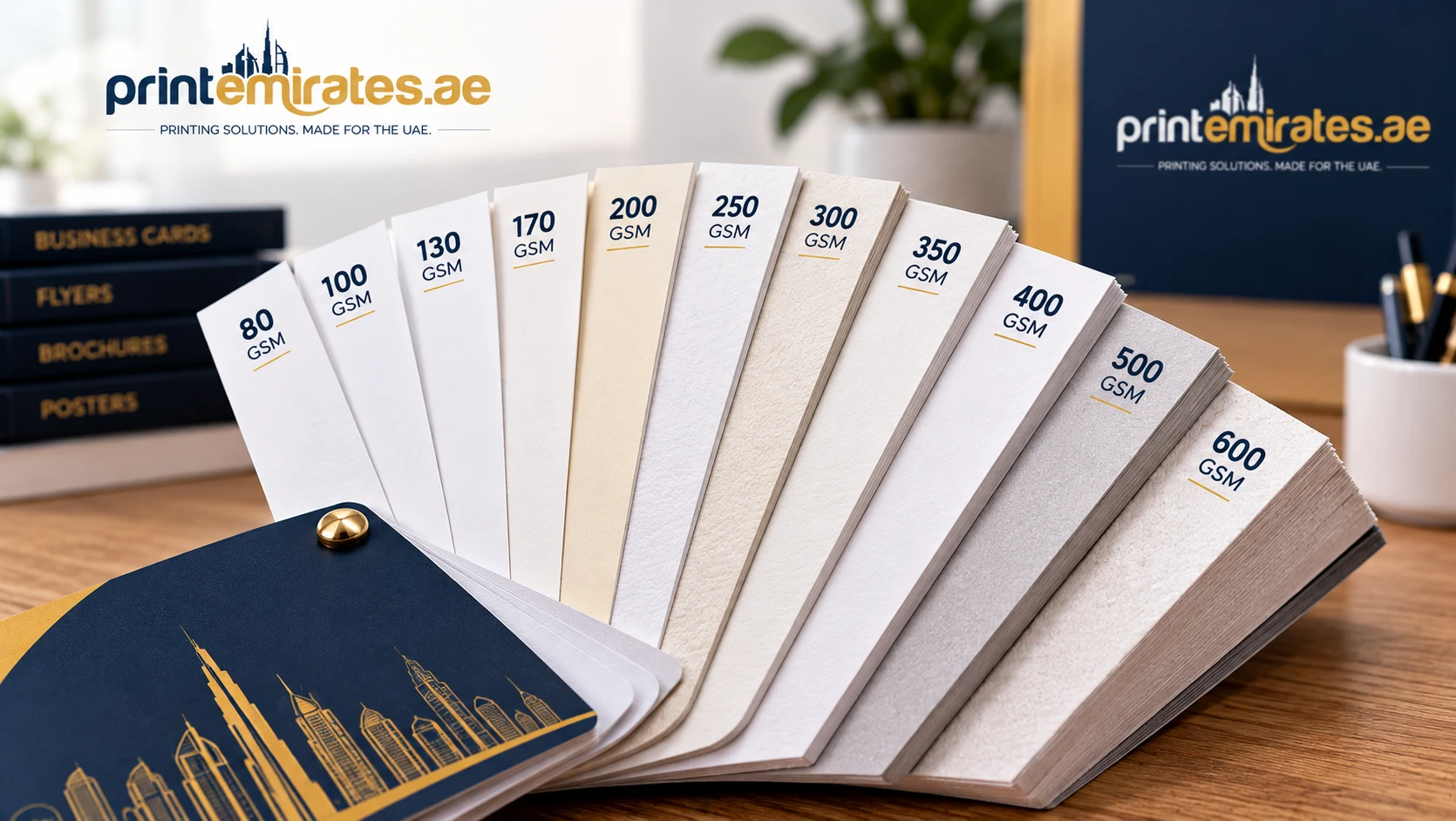
What GSM measures (and what it does not)?
GSM is a simple, standardized number: cut one square meter of the paper and weigh it. A 350gsm sheet from one mill weighs the same as a 350gsm sheet from another, which is why printers quote paper GSM for printing and build price lists around it.
What GSM does not tell you is thickness, stiffness, or surface. Two papers of identical weight can differ noticeably in hand because of how they are made.
GSM versus thickness (microns)
Thickness is measured in microns (µm) or, in older catalogues, in points. Density decides the relationship between weight and thickness:
Acoatedpaper is pressed and filled with mineral coating, so it is dense and relatively thin for its weight. 350 gsm silk is typically around 330–380 µm.
Anuncoatedpaper is more open and bulky, so it is thicker for the same weight. 350 gsm uncoated can reach 400–450 µm.
Bulky or“volume”boardsare engineered to feel thicker still; a 300 gsm bulky board can match a 350 gsm silk in hand.
If a business card must feel thick between the fingers or fit a wallet slot or card holder, thickness is the number to ask for, not just GSM.
Stiffness and grain
Stiffness comes from thickness and fiber direction. Paper has a grain, and a sheet folds cleanly along the grain and reluctantly across it. For folded products, ask the printer to run the grain parallel to the fold; on heavy stock this reduces cracking as much as scoring does.
Coated or uncoated: the second decision
Once you know the weight range, the surface is the next choice. It changes color, feel and use.
Property | Coated (gloss, silk, matt) | Uncoated |
Color reproduction | Sharp, saturated, high contrast | Softer, slightly muted, ink absorbs |
Photographs | Best on gloss or silk | Acceptable; looks natural, less punch |
Feel | Smooth; gloss is slick, silk is soft. | Textured, natural,“paper”feel |
Writing on it | Difficult with ballpoint on gloss; silk is workable. | Easy with any pen |
Fingerprints | Gloss shows them; silk and matt less so | Hidden |
Typical use | Flyers, brochures, most business cards | Letterheads, notepads, premium plain cards |
Laminating | Common, especially on covers and cards | Rare; defeats the natural look |
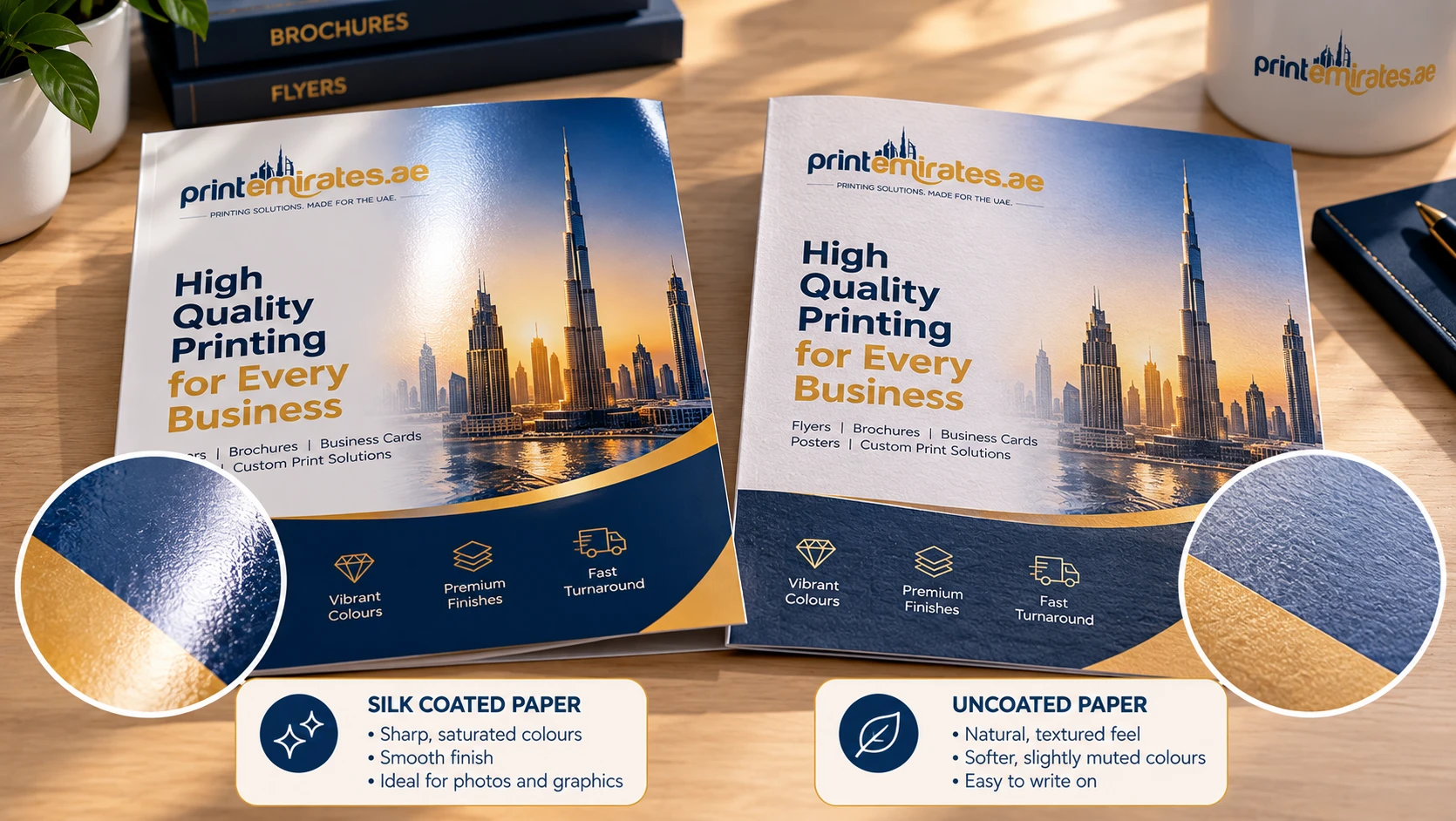
Coated stock comes in three surfaces. Gloss reflects the most light and gives photographs the most depth. Silk (sometimes called satin) sits between gloss and matt and is the default for most brochures and business cards because it reads well and resists glare. Matt is flat and non-reflective and suits text-heavy pages and understated brands.
Uncoated stock is the right choice whenever someone will write on the piece, whenever the brand wants a natural or recycled look, or whenever the item will go through an office laser printer afterwards, which is whyletterheadsare almost always 100–120gsm uncoated.
Typical GSM ranges by weight band
The bands below are industry norms for paper GSM for printing across the UAE and international suppliers.
80–100 gsm: office and everyday
Standard copier paper is 80 gsm. 90–100 gsm is a step up for internal reports, forms, and NCR pads. Too light for anything a customer holds.
100–120 gsm: letterheads and compliment slips
Letterheads sit here because the sheet must still feed through an office printer for the letter itself. 100gsm is the working minimum; 120gsm feels noticeably better in the hand and shows less print-through from the reverse.
130–170 gsm: flyers and leaflets
This is the flyer band. 130 gsm gloss or silk is the economical choice for volume distribution: mailbox drops and handouts at malls and exhibition aisles. 150–170 gsm is better for anything that should feel like a keeper, such as a menu, a price list, or a leaflet placed on a reception desk. Theflyer optionsrun across this range.
170–250 gsm: brochure inners and posters
Folded brochures and booklet inner pages commonly use 150–170 gsm; 200–250 gsm suits self-cover brochures where the same stock is used throughout. Posters for indoor display use 170–200 gsm to hang flat.
250–350 gsm: brochure covers, folders, and postcards
Brochure covers need enough stiffness to protect the inner pages and stand upright on a rack. 250 gsm is the practical minimum, 300 gsm is common, and 350 gsm is the choice when the cover is laminated or when the brochure has many pages.Presentation foldersalso live here, usually at 300–350 gsm with a lamination.
300–400 gsm: business cards
The business card band. 300 gsm is entry level and feels thin next to competitors’ cards. 350 gsm is the UAE standard and works with every finish. 400 gsm is a heavier single-ply option that still fits a standard card holder. For most companies, a 350 gsm silk with matt lamination is the safe specification forbusiness cards.
600 gsm and above: triplex and duplex boards
Above about 450 gsm, single sheets become hard to make and print, so heavy cards are produced by laminating two or three sheets together. A triplex card is three plies, typically 3 × 200 gsm for around 600 gsm total, often with a colored middle layer that shows as a stripe on the edge. Duplex is two plies. These cards are usually reserved for senior staff or luxury brands. They need a die-cut edge and are too thick for some card holders.
Paper GSM for printing by product: quick reference
Product | Typical GSM | Coated or uncoated | Notes |
Letterhead | 100–120 | Uncoated | Must feed through office printers |
Compliment slip | 100–120 | Uncoated | Match the letterhead. |
Envelope | 90–120 | Uncoated | Woven or laid finish |
Notepad / NCR | 70–90 | Uncoated | NCR sets use carbonless coated sheets. |
Flyer, volume distribution | 130–150 | Gloss or silk | Lightest weight that still feels printed |
Flyer, premium, or menu | 170 | Silk or matte | Stands up on a counter |
Folded leaflet (DL, A5) | 150–170 | Silk | Fold along grain. |
Brochure inner pages | 130–170 | Silk or gloss | Saddle-stitched |
Brochure cover | 250–350 | Silk, often laminated | Score before folding above 250 |
Self-cover brochure | 200–250 | Silk | Same stock throughout |
Presentation folder | 300–350 | Silk, laminated | Score all folds and glue tabs |
Postcard | 300–350 | Silk or uncoated | Uncoated reverse for writing |
Business card, standard | 350 | Silk with lamination | The UAE default |
Business card, heavy | 400 | Silk or uncoated | Still fits a standard holder |
Business card, triplex | 600+ | Uncoated plies | Colored core, edge stripe |
Hang tag | 300–400 | Silk or kraft | Drilled hole, string |
When does heavy stock need scoring?
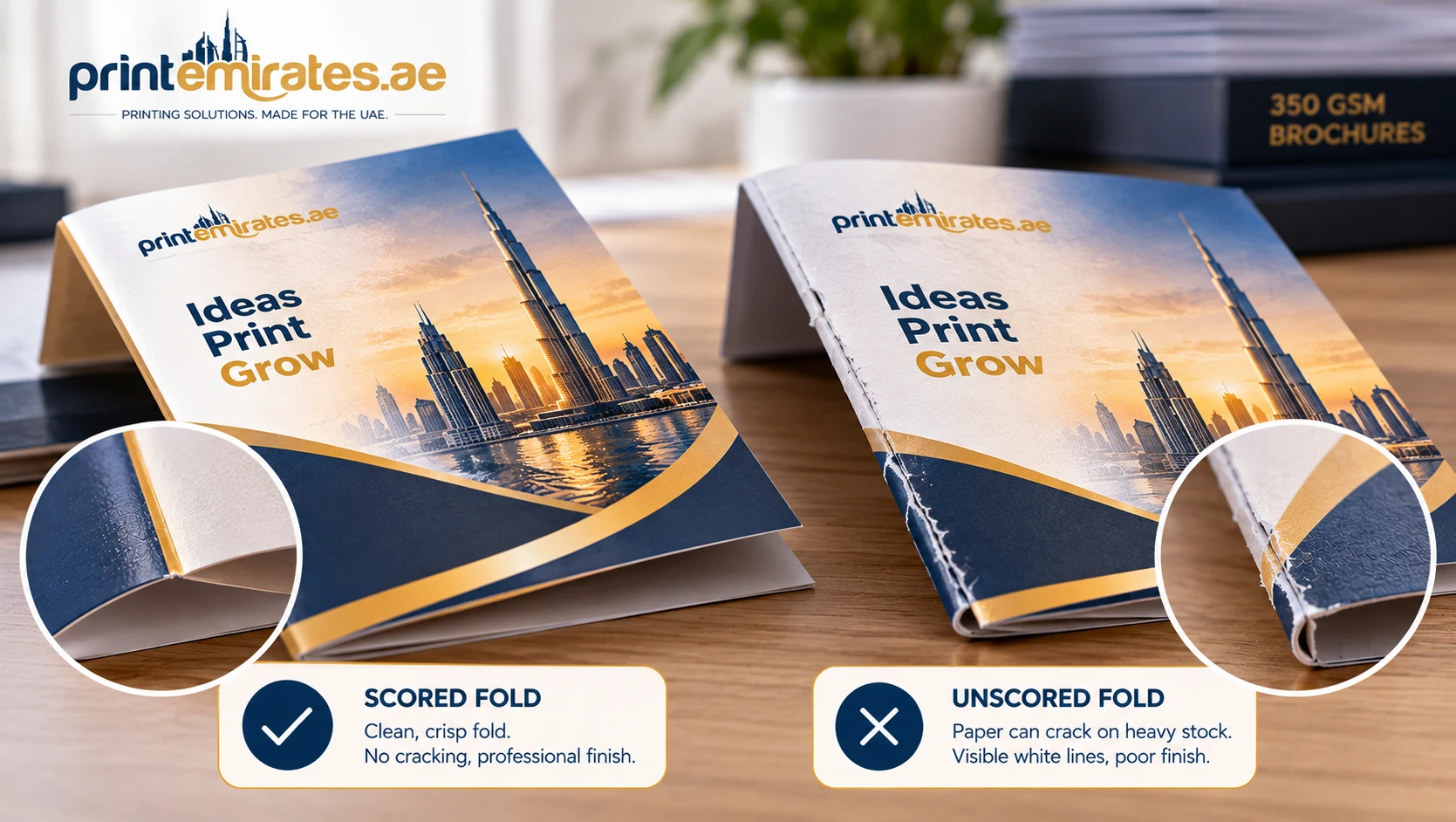
Fold any coated paper above about 200 gsm without preparation, and the fibers on the outside of the fold will crack, showing a white line through the ink. On a dark or solid-color cover, this line is very visible and cannot be repaired after printing.
Scoring
Scoring presses a rounded channel into the sheet before folding, compressing the fibers so they bend rather than break. It is standard for brochure covers, folders, and tent cards at 250 gsm and above. Ask for it on the quote; many printers include it on heavy covers, but check.
Other ways to reduce cracking
- Run the grain parallel to the fold.
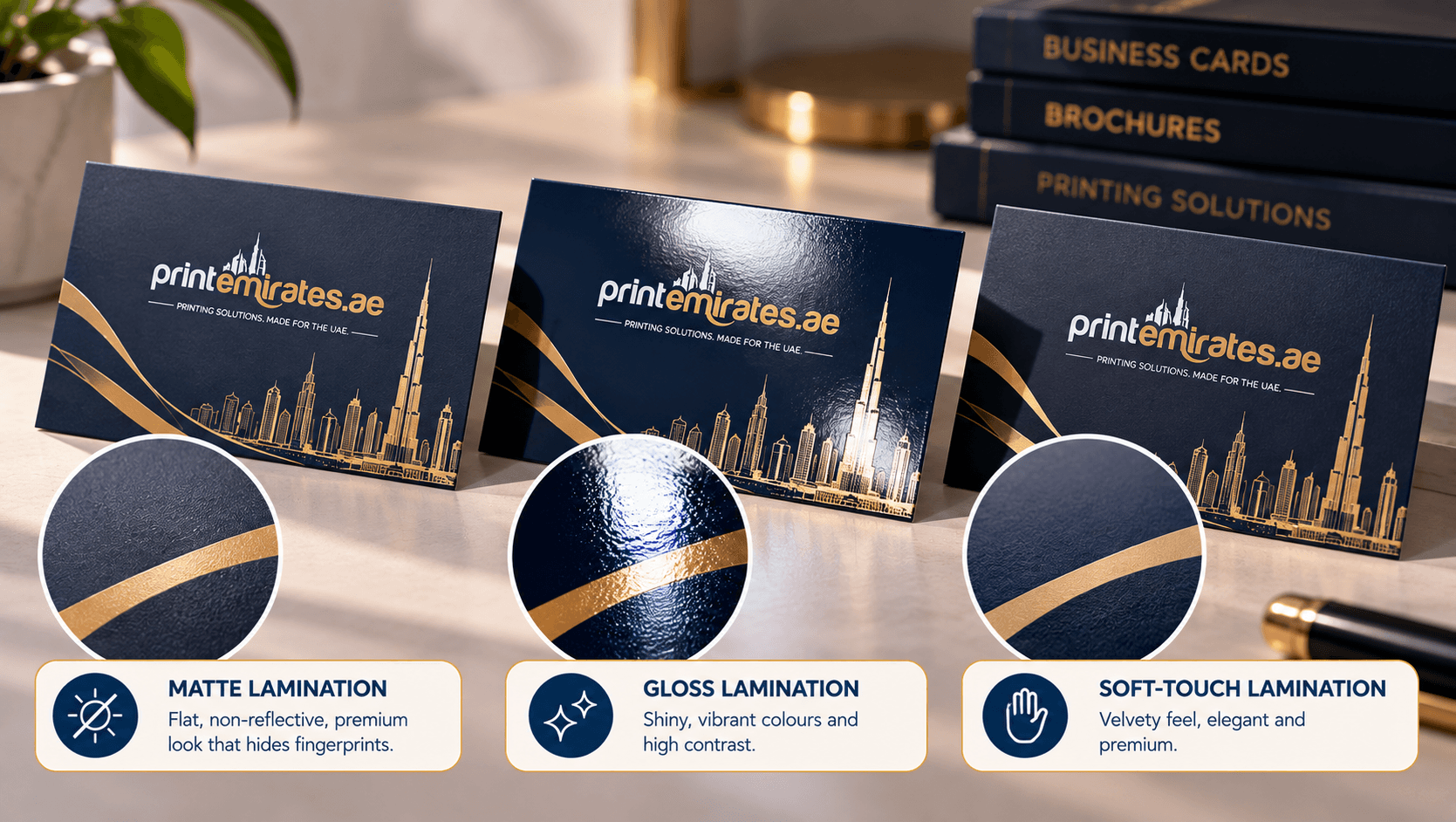
- Laminate the outside surface. Matt or soft-touch lamination covers small cracks and adds flexibility.
- Avoid heavy solid ink right on the fold line; a thin unprinted channel or lighter tint is less likely to show.
- Score before laminating, not after, where the printer’s workflow allows.
Business cards and edge finishing
Business cards are not folded, so cracking is not the issue. Edge quality is. Cards above 400 gsm and all triplex boards should be die-cut rather than guillotined for a clean edge, and painted or gilded edges need the thickness to show.
Setting up artwork for the stock you choose
The stock does not change your artwork dimensions, but it does change how color behaves. Uncoated paper absorbs ink and spreads dots slightly, so images look darker and softer; lighten shadows and increase contrast a touch for uncoated. Coated silk and gloss hold dots precisely and can carry heavier ink coverage.
For all stocks: 3 mm bleed, CMYK, 300 dpi at final size, embedded or outlined fonts, and a print-ready PDF. Theartwork guidehas templates for standard UAE business card sizes and folded leaflet formats with fold lines marked. If you are unsure which stock suits a design, thebusiness printing rangelists the standard weight for each product as a starting point.
Frequently asked questions
Is higher GSM always better?
No. GSM should match the job. A 350gsm letterhead will not feed through an office printer, and a 130gsm business card will feel flimsy. Choose the weight band for the product first, then decide on coating and finish.
What GSM should a business card be?
350gsm is the standard for business cards in the UAE and handles every common finish, including matt lamination and spot UV. Go to 400 gsm or a 600 gsm triplex if you want a noticeably heavier card, and check it fits your card holders.
What is the difference between 130gsm and 170gsm flyers?
130 gsm is thinner and lighter, suited to large-volume handouts where cost per piece matters. 170 gsm is stiffer, stands up on a counter, and feels like a keeper, so it suits menus, price lists, and reception leaflets.
Do I need scoring on a folded brochure?
On coated stock above about 200–250 gsm, yes. Scoring stops the fold cracking and shows a white line through the ink. On lighter inner pages, ordinary folding is fine.
Next step: choose your stock and order!
Pick the product, then the GSM band, then coated or uncoated. Ask for stock samples if you want to feel the difference first. Orderbusiness cards,flyers,orbrochuresonline, orcontact PrintEmirateson WhatsApp or through the Get a Quote form with your artwork and preferred weight.